

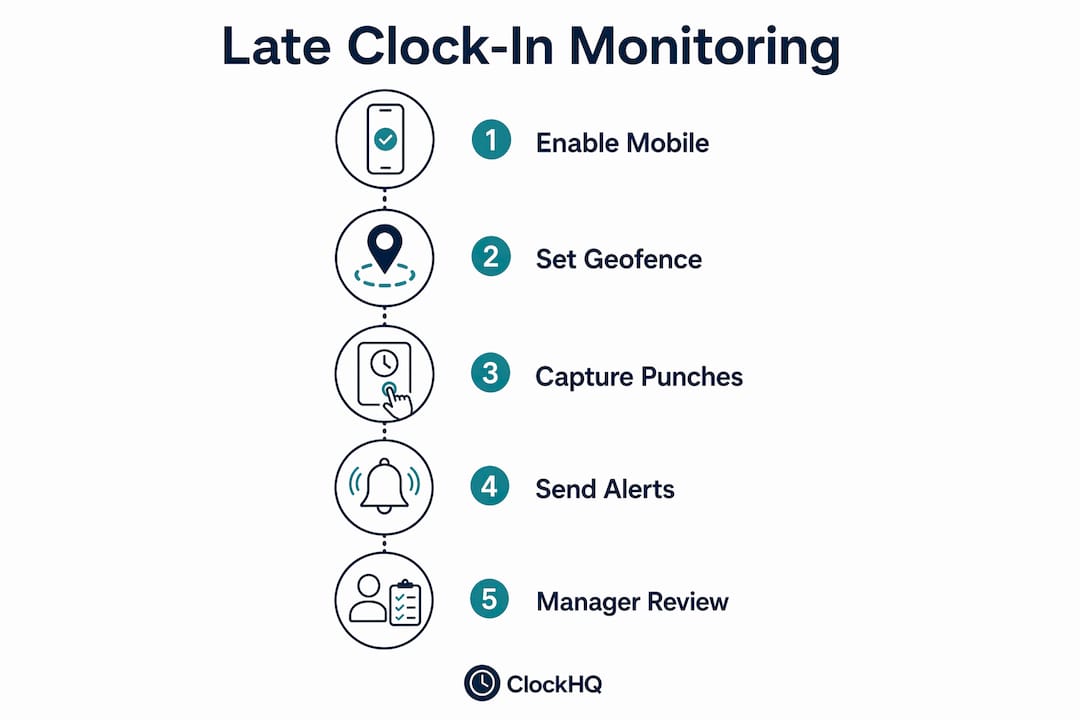
The fastest way to cut late clock-ins is a retail-floor-first combination of real-time clock capture (mobile or kiosk plus geofence), automated late alerts, manager-approval workflows for tardy punches, and disclosed monitoring synced to payroll. You do not need a complicated HR system to get started. Here is what to do before your next shift:
- Enable mobile clock-in or deploy a kiosk at the store entrance so punches are captured on-site the moment a shift starts.
- Set a late threshold of a few minutes and configure automated alerts to notify the floor manager the instant someone crosses it.
- Turn on manager approval for any punch that falls outside the threshold, creating a documented exception at the point of entry.
- Tell your staff, in writing, that attendance is tracked and scored. Disclosed monitoring surfaces exceptions before payroll closes and acts as a deterrent on its own.
- Export exceptions to payroll at the end of each week so no adjustment gets missed. The Fair Labor Standards Act (FLSA) requires accurate time records, and an exportable audit log is your compliance backstop.
Clockhq covers all five steps from a single mobile or desktop app.
Table of Contents
- Why are late clock-ins so hard to catch in retail?
- What system features actually detect late clock-ins?
- How should managers respond when a late alert fires?
- How do policy and communication actually change behavior?
- Which KPIs tell you the program is actually working?
- What does a 30/60/90-day rollout actually look like?
- Key Takeaways
- What managers get wrong when they roll this out
- Clockhq makes it easier to monitor and reduce late clock-ins
- Useful sources and further reading
Why are late clock-ins so hard to catch in retail?
Retail creates conditions that make tardiness easy to miss and hard to fix. High turnover means a significant portion of your floor staff at any given time is new, unfamiliar with the clock-in process, or simply untrained on expectations. A new associate who forgets to punch in on Day 3 is not necessarily gaming the system, but the payroll impact is identical.
Complex schedules compound the problem. Split shifts, staggered start times, and floating coverage roles mean a manager cannot simply glance at the floor at 9:00 AM and know who is late. Someone scheduled for a 10:30 AM prep shift looks absent at 10:00 AM and fine at 10:45 AM, even if they clocked in at 10:42.

Multi-location staffing creates authorization gaps. An employee who works two stores in the same week may clock in at the wrong location or use a device that is not geofenced to their assigned site, generating phantom attendance data that payroll has to untangle manually.
Then there are the blind spots: back-office areas, stockrooms, and prep zones where no kiosk exists and no manager is watching. Retail back-office monitoring research consistently flags these areas as the highest-risk zones for time theft and missed punches. Finally, when exceptions are caught late, payroll reconciliation becomes a manual scramble. Managers edit timesheets from memory, compliance risk climbs, and the root cause never gets addressed.
What system features actually detect late clock-ins?
Not every feature in a time-and-attendance platform earns its place. These are the ones that directly move the needle on tardiness detection, ranked by how quickly they produce results.
Minimum viable set (enable these first):
- Mobile clock-in or on-site kiosk. Captures the punch at the physical location, not from a couch two miles away. Mobile clock-in setup for retail staff reduces forgotten punches and speeds end-of-week reconciliation.
- Geofencing. Draws a virtual boundary around the store. Punches outside that boundary are flagged automatically. Geofence reminders and kiosk features prompt employees to clock in when they enter the job site, eliminating the "I forgot" excuse.
- Automated late alerts with a configurable threshold. Set the threshold at 5 or 7 minutes. The system pings the floor manager the moment it is crossed. Real-time dashboards with instant alerts let managers see who is onsite, who is late, and who is missing without touching a paper timesheet.
- Manager approval for late punches. Require a manager sign-off on any punch that exceeds the threshold. Configuring manager approval for late clock-ins inserts a human verification step at the moment of punch, creating a documented record before the exception reaches payroll.
- Exportable audit logs and payroll sync. Every exception, approval, and edit needs a timestamp and an owner. Automating retail payroll hour exports closes the loop between detection and payroll accuracy.
Advanced options (add once the basics are running):
- Photo verification on punch. Requires a selfie at clock-in, confirming the right person is punching. Less friction than full biometric hardware, and most staff accept it quickly.
- Biometric verification (fingerprint or face recognition). Eliminates buddy-punching entirely. Worth the setup cost for high-volume stores with chronic attendance issues.
- Live manager dashboard. A single screen showing real-time floor coverage, late flags, and no-shows. Shifts managers from reactive payroll fixes to proactive scheduling adjustments.
Pro Tip: Start with photo-on-punch before committing to biometric hardware. It catches buddy-punching, requires no additional devices, and staff acceptance is significantly higher than fingerprint scanners. You can always upgrade later.
How should managers respond when a late alert fires?
A late alert is only useful if the manager knows exactly what to do next. Here is a repeatable, shift-by-shift workflow.
- Receive the alert. The system flags the late punch. The manager sees it on the dashboard or via push notification within seconds of the threshold being crossed.
- Verify coverage. Before anything else, confirm the floor is covered. Reassign a task or pull someone from break if the late employee handles a critical station.
- Approve or flag the punch. If the employee has arrived and clocked in late, approve the punch and assign a resolution code (e.g., "Excused Absence," "Unexcused Late," "Transportation"). Dayforce's manager timesheet guide documents how to handle resolution codes and bulk exceptions, which is useful if you are managing a multi-employee late event.
- Message the employee. Keep it factual and brief. A template that works: "Hi [Name], I approved your clock-in for [time]. Please see me before your next shift to discuss. Thanks." No accusations, no lengthy explanation on the floor.
- Log the resolution. Record the timestamp, the resolution code, and your approval in the system. This is your audit trail.
- Escalate if needed. If the employee is a no-show past 30 minutes, notify HR and begin coverage documentation. Most stores set a 30-minute window before a no-show triggers an HR ticket.
Weekly payroll reconciliation checklist:
- Pull the exception report for the week.
- Confirm every late punch has a resolution code and manager approval.
- Identify employees with two or more late events in the week.
- Flag unresolved exceptions before the payroll run closes.
- Export the audit log and attach it to the payroll file.
For a deeper look at handling shift coverage gaps when late arrivals leave the floor short, the operational tips there translate directly to retail floor management.

How do policy and communication actually change behavior?
Technology catches late clock-ins. Policy and communication prevent them. The distinction matters because a manager who relies entirely on alerts ends up spending every shift reacting instead of running the floor.
A clear written policy does three things: it defines what "late" means, states the documentation requirement, and outlines the progressive steps for repeat offenses. A workable short-form policy looks like this:
- Definition: An employee is considered late if they clock in more than 5 minutes after their scheduled start time.
- First occurrence: Verbal acknowledgment, documented in the system.
- Second occurrence within 30 days: Written notice, manager signature required.
- Third occurrence within 30 days: HR review, potential schedule adjustment.
- Manager approval: Any late punch requires manager approval before payroll processes it.
The most underused lever in retail attendance management is disclosed monitoring. Telling staff during onboarding and at shift huddles that attendance is tracked and scored changes behavior before any alert fires.
Disclosed monitoring surfaces attendance anomalies before payroll closes. When employees know that exceptions are flagged automatically, the deterrent effect reduces irregularities without requiring continuous confrontation from managers.
Post a short notice at each clock-in kiosk: "Attendance is tracked and recorded. Late arrivals require manager approval." That one sentence does more work than most disciplinary conversations. Hubstaff's research on employee awareness of monitoring confirms that staff who know they are being monitored adjust their behavior, but hidden monitoring erodes trust when discovered. Transparency is both more effective and less risky.
One compliance note: keep all attendance documentation and payroll adjustments auditable to meet FLSA record-keeping requirements. This is not legal advice; confirm your specific obligations with a qualified employment attorney or HR professional.
Pro Tip: Add a 60-second attendance reminder to your pre-shift huddle once a week. Managers who mention the tracking system regularly see fewer repeat late events than those who only address it during disciplinary conversations.
Which KPIs tell you the program is actually working?
Measuring the right things keeps the program from becoming a paperwork exercise. Track these five metrics from Day 1.
- Late rate: Percentage of shifts with a late clock-in. Calculate weekly. A healthy target for most retail stores is to keep late clock-ins to a low percentage of total shifts.
- Repeat-late employees: Number of employees with two or more late events in a rolling 30-day window. This is your early-warning list for behavioral intervention.
- No-show rate: Percentage of scheduled shifts with no clock-in at all. Tracks the more severe end of the attendance problem.
- Payroll exception count: Number of punches that required manual adjustment in a given pay period. Declining exceptions signal that the system is working.
- Payroll leakage estimate: Total hours adjusted downward in a pay period. Even small per-shift overages add up across a full store roster.
Reporting cadence:
- Daily: Manager dashboard review, late alerts actioned.
- Weekly: Exception report pulled, resolution codes confirmed, repeat-late list reviewed.
- Monthly: Payroll reconciliation audit, trend comparison against prior month, KPI targets reviewed.
For a 30/60/90-day program, reasonable improvement targets look like this: by Day 30, every late punch has a resolution code and manager approval (zero unresolved exceptions). By Day 60, the late rate drops noticeably from baseline as staff adjust to disclosed monitoring. By Day 90, payroll exception counts are trending down and the repeat-late list is shorter than it was at launch. Real-time dashboards make these trends visible without manual spreadsheet work.
What does a 30/60/90-day rollout actually look like?
A phased approach prevents the common mistake of enabling every feature at once and overwhelming managers before they have built the habit.
Days 1–30: Foundation
- Update the attendance policy and distribute it in writing to all staff.
- Enable mobile clock-in or deploy a kiosk at the store entrance. Follow the mobile clock-in setup guide for configuration steps.
- Set the geofence radius to cover the typical single-store footprint.
- Configure the late-alert threshold to a recommended short interval.
- Enable manager approval for late punches.
- Train floor managers on the alert workflow and resolution codes.
- Post kiosk signage disclosing that attendance is tracked.
Days 31–60: Refinement
- Pull the first exception report and review resolution code usage.
- Enable photo verification on punch if buddy-punching is suspected.
- Set up the weekly exception report and assign an owner (store manager or HR coordinator).
- Identify the top repeat-late employees and schedule brief check-ins.
- Connect the time-and-attendance system to your payroll export. Review the payroll export setup to confirm audit-log fields are captured correctly.
Days 61–90: Optimization
- Review the 60-day KPI baseline: late rate, exception count, payroll leakage.
- Adjust the geofence radius or alert threshold if false positives are high.
- Pilot biometric verification if photo-on-punch is not sufficient.
- Conduct a payroll reconciliation audit comparing pre- and post-implementation exception counts.
- Brief regional HR on results and confirm escalation paths for chronic no-shows.
Minimal tech configuration for immediate impact:
- Mobile clock-in or kiosk: enabled
- Geofence radius: 100–150 feet
- Late-alert threshold: 5–7 minutes
- Manager approval toggle: on
- Audit-log export: scheduled weekly
Involve store managers, regional HR, and payroll from Day 1. The system catches exceptions; the people decide what to do with them.
Key Takeaways
Monitoring late clock-ins on the retail floor requires real-time clock capture, automated alerts, manager-approval workflows, disclosed monitoring, and payroll-synced audit logs working together from Day 1.
| Point | Details |
|---|---|
| Enable real-time clock capture first | Mobile clock-in plus geofencing stops out-of-location punches and reduces missed clock-ins immediately. |
| Automate late alerts with a threshold | Set a 5–7 minute threshold and route alerts to the floor manager so coverage gaps are addressed in real time. |
| Require manager approval for late punches | Every tardy punch gets a resolution code and a manager signature before it reaches payroll. |
| Disclosed monitoring changes behavior | Telling staff attendance is tracked and scored reduces repeat late events without continuous disciplinary action. |
| Clockhq covers the full workflow | Clockhq's mobile clock-in, geofence, manager approval, and payroll export features map directly to this implementation plan. |
What managers get wrong when they roll this out
Most rollouts stumble in the same two places, and neither of them is the technology.
The first is skipping manager training. A late alert that fires and gets ignored is worse than no alert at all. It tells staff the system is not enforced, and within two weeks, tardiness climbs back to baseline. The fix is simple: run a 20-minute walkthrough with every floor manager before go-live, covering exactly what to do when an alert appears. The common clock-in irregularities guide lists the most frequent manager errors and how to correct them before they become habits.
The second pitfall is over-automation without communication. Enabling every feature simultaneously, without telling staff what changed or why, creates confusion and resentment. Employees who discover they are being monitored without prior notice tend to interpret it as distrust rather than a standard operational practice. That interpretation damages retention, which is already a pressure point in retail. The answer is not to monitor less. It is to disclose more, earlier, and frame it as a fairness mechanism: everyone is held to the same standard, and the system makes that standard visible.
One thing that surprises managers during the first 30 days: the repeat-late list is almost always shorter than expected. Most late clock-ins come from a small number of employees, and a direct conversation after the first or second flag resolves the majority of cases. The system's real value is not catching bad actors. It is giving managers the data to have that conversation with confidence instead of relying on memory.
Clockhq makes it easier to monitor and reduce late clock-ins
Retail managers who want a low-friction way to put this entire framework into practice without stitching together multiple tools will find Clockhq covers the essentials in one place.
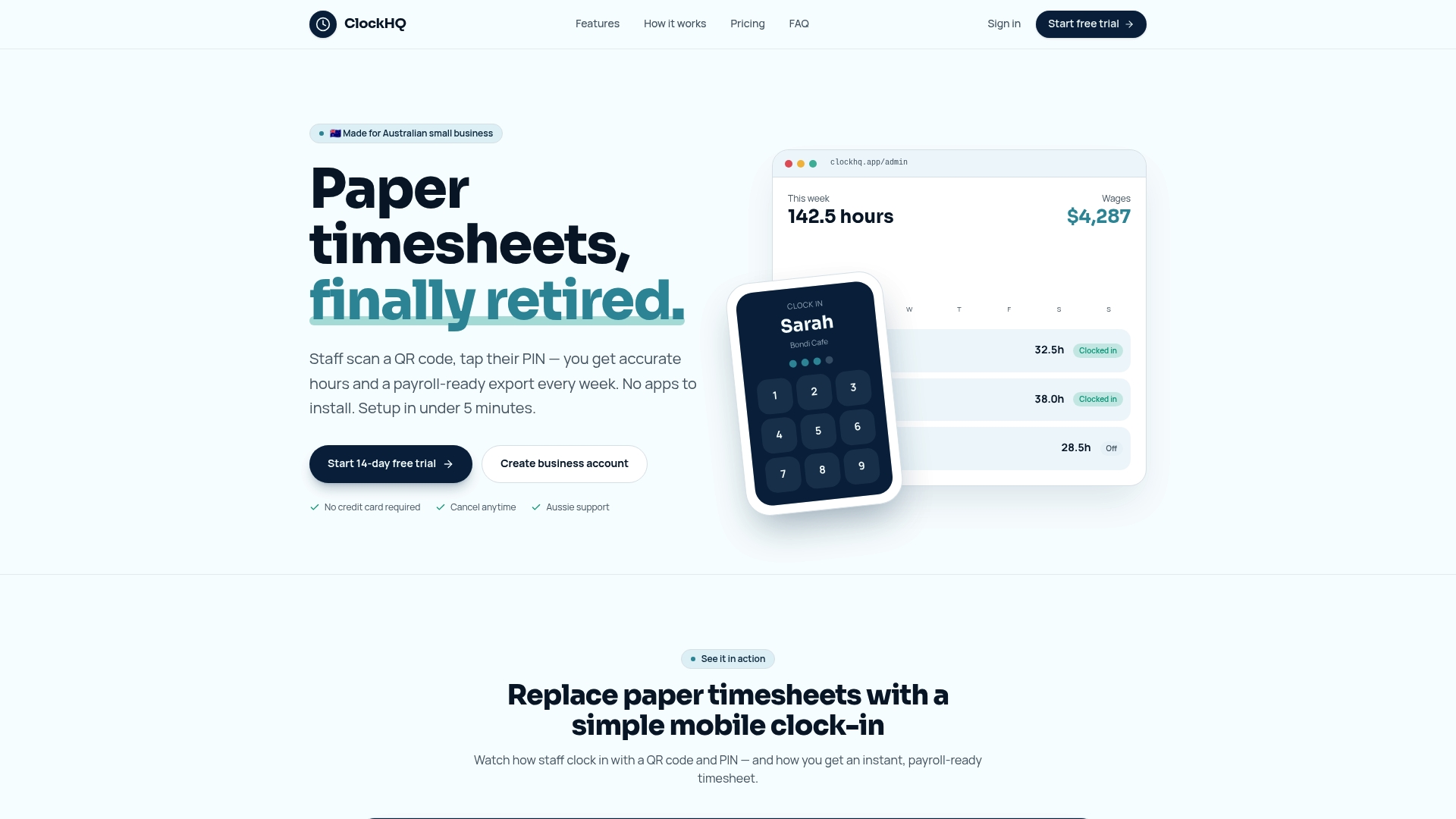
Clockhq's mobile clock-in captures punches on-site the moment a shift starts, and the built-in geofence flags any punch outside the store boundary automatically. The manager dashboard shows who is onsite, who is late, and who has not clocked in, in real time, so coverage decisions happen in seconds rather than after a phone-around. Manager approval for late punches is a toggle, not a configuration project. And when the pay period closes, the audit-log export gives payroll everything it needs to reconcile exceptions without manual timesheet edits.
For stores running a 30-day pilot, the recommended starting configuration is: enable mobile clock-in, set the geofence to 100–150 feet, configure a 5-minute late alert, turn on manager approval, and schedule a weekly audit-log export. That is a morning's work. From there, Clockhq's timesheets and retail compliance guide walks through the payroll record-keeping steps that keep you on the right side of FLSA requirements.
Start a free trial at clockhq.app and have the core configuration running before your next shift.
Useful sources and further reading
- How to Set Up Mobile Clock-In for Retail Staff — Step-by-step Clockhq setup guide for enabling mobile clock-in and reducing missed punches on the retail floor.
- Common Clock-In Irregularities in Retail: 10 Key Fixes — Practical fixes for the most frequent clock-in problems retail managers encounter, including kiosk placement and manager approval rules.
- Automate Retail Payroll Hour Exports in 2026 — Clockhq guidance on configuring exportable audit logs and exception reporting for payroll accuracy.
- AIfinitive for Retail: Back Office Monitoring & Time Theft Detection — Research-backed overview of disclosed monitoring as a deterrent for attendance irregularities and time theft in retail environments.
- Track Onsite, Late, or Missing Staff in Real Time — Explains how real-time dashboards and instant alerts reduce payroll discrepancies and enable proactive scheduling adjustments.
- Resolve Tardies: Dayforce Manager Guide — Reference for resolution codes and bulk exception handling; useful for building your own tardiness workflow.
- Time Tracking in Retail: Beyond the Clock-Ins — Industry perspective on how time-tracking systems support store productivity and compliance beyond basic punch capture.