

The highest-impact part-time worker scheduling best practices are: publish rosters at least 7–14 days ahead, collect hard availability separately from soft preferences, build a predictable core schedule, enable manager-approved shift swaps, enforce clear time-off rules, track hours and overtime accurately, and use digital scheduling tools to reduce errors. A randomized field experiment at Gap found that responsible scheduling practices increased store productivity by 5.1%, driven by a 3.3% sales increase and a 1.8% decrease in labor costs. That is not a soft HR win. It goes straight to the bottom line.
Quick checklist — copy this into your next team meeting:
- Publish the next schedule at least 7 days out (14 days where state law requires it)
- Record hard availability (cannot work) separately from soft preferences (prefer not to work)
- Assign a predictable core shift to your most reliable part-timers
- Set a written shift-swap policy with a notice window and manager sign-off
- Document time-off request deadlines and approval criteria
- Track daily hours, breaks, and weekly overtime against federal and state thresholds
- Export payroll-ready timesheets weekly to catch errors before payday
- Review fill rate, no-show rate, and overtime percentage monthly
Table of Contents
- What are the best practices for scheduling part-time workers in advance?
- How should you collect employee availability from part-time staff?
- How do you design predictable shifts that actually reduce turnover?
- How do you handle shift swaps, time-off requests, and schedule communication?
- What U.S. compliance rules apply to part-time rosters?
- Do predictable schedules actually improve business results?
- Which KPIs tell you if your scheduling is actually working?
- Key Takeaways
- What actually changes when you commit to a core schedule
- Clockhq makes these scheduling practices easier to run
- Useful sources and quick links
What are the best practices for scheduling part-time workers in advance?
Publish your next roster at least 7 days before it takes effect. Many U.S. states and cities go further. Predictive-scheduling laws in jurisdictions like San Francisco, Chicago, and New York commonly require 7–14 days' advance notice. Even where no law applies, early publication cuts no-shows, gives staff time to arrange childcare or second jobs, and makes payroll forecasting far less chaotic.
A simple weekly publication workflow:
- Pull demand data (sales forecasts, reservation counts, delivery volumes) by Wednesday.
- Draft the roster Thursday and route it to a second approver by end of day.
- Publish the finalized schedule Friday morning for the following week.
- Lock edits by Sunday evening; any change after that requires a manager override.
- Send a push notification or text blast the moment the schedule goes live.
For biweekly operations, shift the draft window two weeks out and add a mid-cycle review on Day 7 to catch demand changes.
Pro Tip: Keep a small float of two or three cross-trained staff who have opted into a backup list. When a last-minute demand spike hits, you call the list before you scramble. This preserves your advance-publication discipline without leaving you short-staffed.
How should you collect employee availability from part-time staff?
Treat availability as two separate data fields, not one. The U.S. Chamber of Commerce frames it clearly: hard availability means the employee cannot work those hours under any circumstances (a second job, a custody arrangement, a class schedule). Soft preferences mean they would rather not work those hours but can if needed. Mixing the two is how you end up scheduling someone who genuinely cannot show up.
Fields to capture on your availability form:
- Recurring unavailable days and times (hard constraint)
- One-off blockout dates for the next 4–8 weeks
- Preferred dayparts (morning, midday, evening, overnight)
- Maximum weekly hours the employee wants
- Minimum weekly hours they need to make rent
- Commuting constraints (last bus, school pickup)
- Willingness to pick up extra shifts on short notice (yes/no/sometimes)
Build this as a simple Google Form or paper survey and review it every 60 days. Availability changes. A student's semester ends; a parent's childcare situation shifts. If your roster is built on stale data, you will keep hitting the same coverage gaps.
For a deeper look at managing availability data as a single source of truth, the Clockhq blog covers the full workflow.

How do you design predictable shifts that actually reduce turnover?
Build a core schedule first, then layer flexibility on top. The Stable Scheduling Study tested a bundled approach in retail that included stable shift structures, core scheduling, tech-enabled shift swapping, and a concept called Part-time Plus: a soft guarantee of 20 or more hours per week for a designated core group. The result was greater schedule predictability without reducing average hours for other part-time staff. Managers worried about cost trade-offs can take that as a direct answer.
Three common shift patterns, compared:
| Pattern | Predictability | Staffing agility | Admin overhead |
|---|---|---|---|
| Fixed day blocks | High | Low | Low |
| Rotating shifts (e.g., 4-3-3-4) | Medium | Medium | Medium |
| Core + flexible pool | High for core; medium for pool | High | Medium-high |
Pros and cons at a glance:
- Fixed day blocks: Staff love the consistency; managers lose flexibility when demand spikes. Best for operations with flat, predictable demand.
- Rotating shifts: Spreads weekend and closing burden fairly, but some staff find the variation stressful. Works well in hospitality and healthcare.
- Core + flexible pool: Gives your best performers stability while keeping a bench for variable demand. Requires more active roster management but consistent scheduling measurably improves morale and cuts administrative churn.
Concrete examples managers can adapt: a morning anchor shift (6:00 AM–2:00 PM, same days each week) for your core team, plus an evening pool (4:00 PM–10:00 PM, days vary) filled from your backup list based on weekly demand.
How do you handle shift swaps, time-off requests, and schedule communication?
Allow swaps, but put guardrails around them. A swap without manager approval is just an undocumented absence waiting to happen.
A short policy template you can adapt:
- Request window: Swap requests must be submitted at least 48 hours before the shift starts (72 hours for weekend shifts).
- Eligibility: Both employees must be trained for the role and must not exceed their weekly hour cap after the swap.
- Approval: The manager reviews and approves or denies within 24 hours. No swap is confirmed until the manager signs off.
- Documentation: All swaps are logged in the scheduling system with both names, the original shift, and the new assignment.
- Fallback: If no eligible swap partner is found, the original employee remains responsible for the shift.
For no-shows, keep a tiered response: first, call your backup list; second, offer the shift to an on-call employee at a premium; third, redistribute hours across the existing crew if coverage allows. Jumping straight to overtime is expensive and burns out your reliable staff.
On communication: post the schedule in at least two channels. A mobile push notification works for staff who check their phones constantly. A printed copy on the break-room wall catches everyone else. For schedule updates mid-week, a group text or app notification with a clear subject line ("Schedule change: Tuesday 3/18, 2:00 PM shift") prevents confusion.

What U.S. compliance rules apply to part-time rosters?
Track hours, breaks, and overtime accurately and keep those records. Accurate records are both a compliance requirement and your best defense in a wage dispute.
The immediate must-dos:
- Overtime: Under the federal Fair Labor Standards Act, non-exempt employees earn overtime at 1.5x their regular rate for hours over 40 in a workweek. Some states (California, for example) calculate daily overtime at 8 hours. Know which rule applies to each employee.
- Breaks: Federal law does not mandate meal breaks for adults, but many states do. Short rest breaks of 20 minutes or less are generally compensable under federal rules.
- Predictive-scheduling notice: If you operate in a covered city or state, late schedule changes may trigger premium pay. Check your jurisdiction.
- Record retention: The Department of Labor requires employers to retain payroll records for at least three years and time-and-earnings records for two years.
- Time-clock accuracy: Round-up or buddy-punch errors compound fast. Digital clock-in with a unique PIN or QR code eliminates most of them.
Recordkeeping checklist for audits and payroll runs:
- Daily clock-in and clock-out times for every shift
- Total hours per employee per workweek
- Break times taken (and whether they were paid or unpaid)
- Overtime hours flagged and approved
- Any schedule changes with the date and reason documented
- Payroll export file retained alongside the timesheet records
For digital timesheet benefits that support audit readiness, Clockhq's blog covers the practical case in detail.
Legal note: This article is general information, not legal advice. Overtime thresholds, break requirements, and predictive-scheduling rules vary by state and locality. Confirm the rules that apply to your specific operation with a qualified employment attorney or your state labor agency before making policy changes.
Do predictable schedules actually improve business results?
Yes, and there is controlled evidence for it. A randomized field experiment at Gap, Inc. tested responsible scheduling practices across retail stores and measured the financial outcomes directly.
Study result: Implementing responsible scheduling at Gap increased store productivity by 5.1%, driven by a 3.3% increase in sales and a 1.8% decrease in labor costs. This was a controlled experiment, not a survey. The productivity gain came from better execution, not from adding headcount.
That finding matters because it reframes the conversation. Predictable scheduling is not a concession to employees. It is an operational lever.
Sample weekly schedule template (adapt for your operation):
| Shift | Monday | Tuesday | Wednesday | Thursday | Friday | Saturday | Sunday |
|---|---|---|---|---|---|---|---|
| Morning (6 AM–2 PM) | Alex, Jordan | Alex, Jordan | Alex, Morgan | Alex, Jordan | Alex, Jordan | Morgan, Sam | Morgan, Sam |
| Midday (10 AM–6 PM) | Morgan | Sam | Sam | Morgan | Sam | Alex | Jordan |
| Evening (2 PM–10 PM) | Sam | Morgan | Jordan | Sam | Morgan | Jordan | Alex |
Key scheduling tool features to look for:
| Feature | Why it matters |
|---|---|
| Mobile roster publishing | Staff see their schedule instantly, anywhere |
| Availability capture (hard + soft) | Prevents unworkable assignments at the source |
| Shift swap workflow | Keeps swaps documented and manager-approved |
| Automatic overtime alerts | Flags threshold breaches before they hit payroll |
| Payroll-ready CSV export | Eliminates manual timesheet re-entry errors |
Clockhq covers all five. Managers can capture hard and soft availability per employee, publish rosters to staff via browser or mobile without requiring an app download, run a shift-swap workflow with manager approval built in, get automatic break and overtime detection, and export payroll-ready CSV files directly. For retail and hospitality operations running part-time crews, the shift management tips on the Clockhq blog show how these features map to real operational workflows.
Which KPIs tell you if your scheduling is actually working?
Run a weekly operational check and a monthly trend review. The weekly check catches fires; the monthly review tells you whether the system is improving.
The five KPIs worth tracking:
- Fill rate: Shifts filled on time / total shifts scheduled. Anything below 95% signals a coverage or availability problem.
- Schedule adherence: Actual hours worked / scheduled hours. A gap here usually means no-shows or unauthorized early departures.
- Overtime percentage: Overtime hours / total hours worked. High overtime on a part-time crew often means the core schedule is understaffed or availability data is wrong.
- Cost per covered hour: Total labor cost / total hours actually worked. Tracks efficiency across schedule changes.
- Scheduling-related turnover: Exit interviews that cite schedule unpredictability as a reason for leaving. Track this separately from total turnover.
Weekly review checklist (15 minutes, manager only):
- Compare scheduled vs. actual hours for each employee
- Flag any overtime that was not pre-approved
- Note no-shows and whether the backup list was used
- Confirm next week's schedule is published and acknowledged
Monthly review checklist (30 minutes, manager + HR or owner):
- Review all five KPIs against the prior month
- Identify any employee whose availability data has not been updated in 60+ days
- Check whether any predictive-scheduling notice windows were missed
- Adjust core schedule assignments if fill rate or adherence has dropped
Key Takeaways
Effective part-time worker scheduling requires publishing rosters early, separating hard availability from soft preferences, building a predictable core schedule, and tracking a small set of KPIs weekly.
| Point | Details |
|---|---|
| Publish schedules 7–14 days early | Reduces no-shows, supports predictive-scheduling compliance, and makes payroll forecasting manageable. |
| Separate hard availability from soft preferences | Prevents unworkable assignments and reduces turnover caused by scheduling conflicts. |
| Build a core schedule with Part-time Plus | A soft 20+ hour guarantee for a core group improves execution without reducing hours for other staff. |
| Track five KPIs weekly and monthly | Fill rate, adherence, overtime %, cost per covered hour, and scheduling-related turnover reveal problems before they compound. |
| Use Clockhq to operationalize each practice | Clockhq captures availability, publishes rosters, manages shift swaps, detects overtime, and exports payroll-ready CSV files from one platform. |
What actually changes when you commit to a core schedule
Most managers I have talked with about this topic stumble at the same point: they adopt the core schedule idea enthusiastically, then quietly abandon it after two weeks of demand volatility. The schedule bends to cover a busy Saturday, then a sick call, and before long it looks exactly like the chaotic roster they started with.
The fix is not more discipline. It is a smaller core. Start with two or three employees who genuinely want consistent hours and build the predictable block around them. Let the rest of the schedule stay flexible. That small anchor is enough to stabilize execution without locking you into a structure that breaks under real-world pressure.
The other common stumble is fairness perception. When some staff get a soft hours guarantee and others do not, resentment builds fast. Be transparent about the criteria: the core group is defined by availability consistency and role coverage, not favoritism. Put that in writing before you announce it.
If I could point to one change that moves the needle fastest, it is the availability form. Not the software, not the KPI dashboard. Just a clean, two-field form that separates cannot-work from prefer-not-to-work, reviewed every 60 days. Every other improvement in this article depends on that data being accurate.
Clockhq makes these scheduling practices easier to run
Clockhq is built for exactly the kind of small-business scheduling this article describes: part-time crews, variable demand, and managers who do not have time to babysit a spreadsheet. The concrete advantage over manual methods is that availability capture, roster publishing, shift swaps, overtime detection, and payroll export all live in one place. No re-keying data between systems. No missed overtime flags buried in a spreadsheet column.
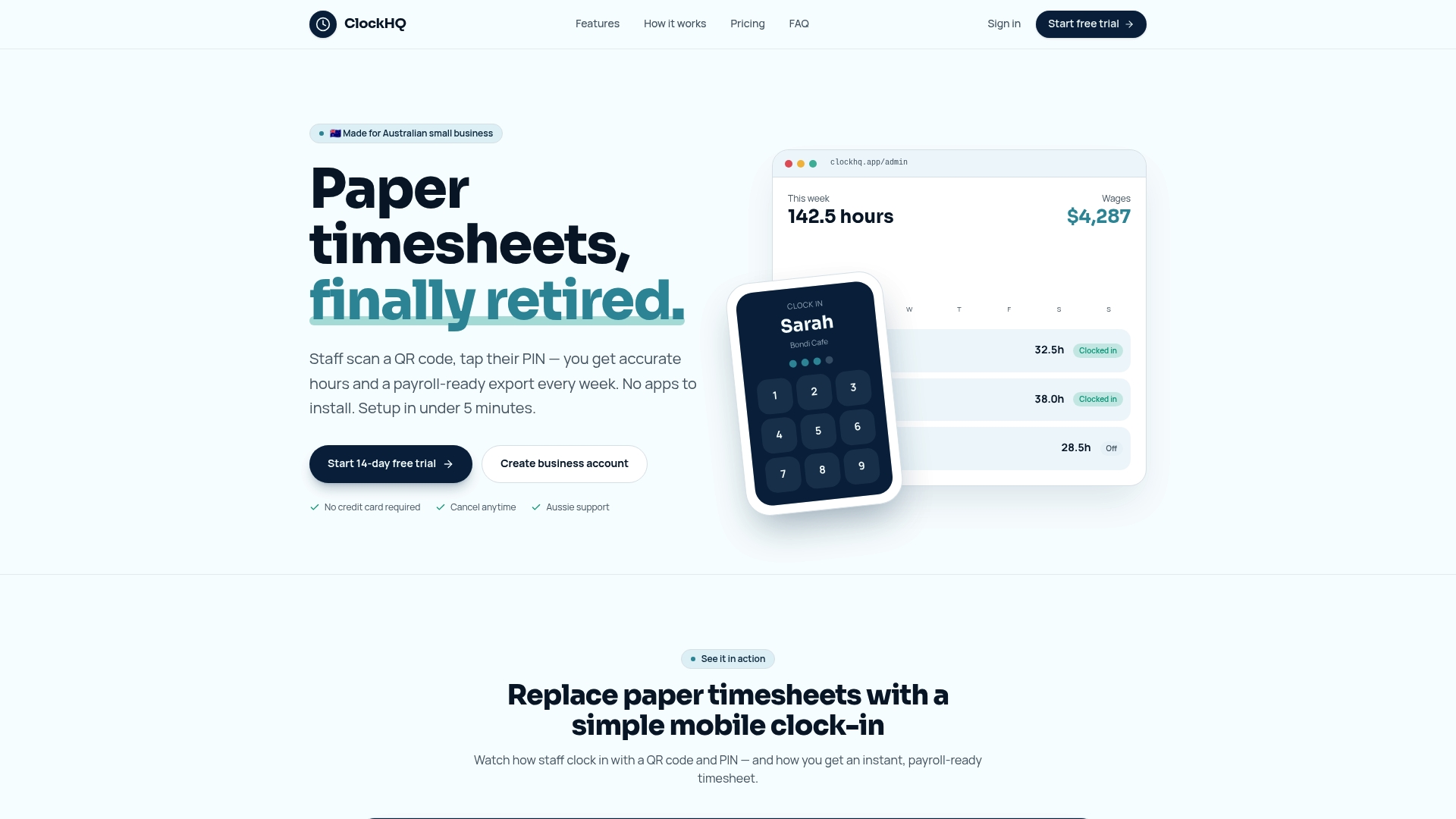
During a 14-day free trial, a manager can be fully set up in under an hour:
- Add your staff and set their roles.
- Capture hard and soft availability for each employee.
- Publish your first roster via browser or mobile. Staff see it immediately, no app download required.
- Enable the shift-swap workflow so requests route to you for approval.
- At the end of the week, export a payroll-ready CSV and hand it to your bookkeeper.
Unlimited staff are included from day one. Start your free trial at Clockhq and have your first roster published before the week is out.
Useful sources and quick links
Research cited in this article:
- Gap, Inc. responsible scheduling experiment: The Management Science paper behind the 5.1% productivity finding. Read this if you need to make the business case to a skeptical owner or CFO.
- Stable Scheduling Study Report: The full report on core scheduling, Part-time Plus, and stable shift structures in retail. Covers implementation detail and financial outcomes.
- U.S. Chamber of Commerce: Managing Part-Time Employee Schedules: Practical HR guidance on availability collection and predictive-scheduling notice requirements.
- U.S. Department of Labor: Hours of Work: Federal record-retention requirements and overtime rules.
Clockhq resources for follow-up:
- Employee availability management guide: Full walkthrough of hard vs. soft availability fields and single-source-of-truth roster management.
- Why scheduling software reduces workplace stress: The business case for digital rostering, including morale and retention data.
- Digital timesheets for your business: How payroll-ready exports cut errors and support compliance recordkeeping.
For managers in care and household services, CareTracker offers time-tracking built specifically for nannies and caregivers, which pairs well with the availability and scheduling principles covered here.